
Biofouling Control at Altamira V Power Plant
Facility Profile
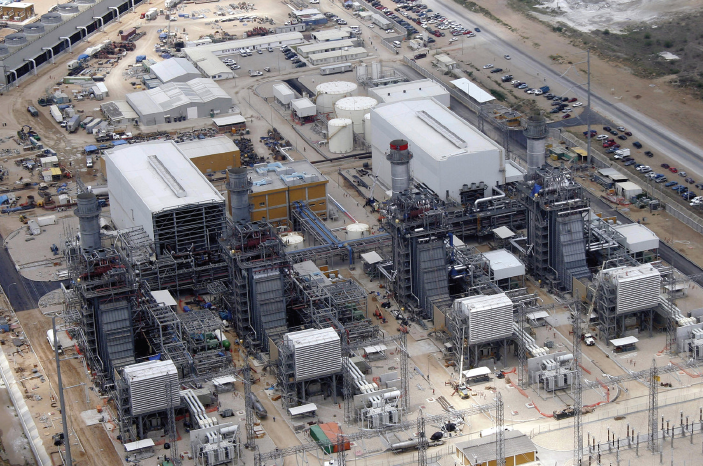
Atimira V Power Plant is a 1,150 MW combined cycle power generation facility built in 2006. The facility is located inside the Port of Altamira, an important industrial port servicing heavy industry in the Gulf of Mexico.
In order to avoid biofouling on piping and equipment exposed to seawater, a hypochlorite solution is continuously dosed prior to the seawater intake pumps to maintain a chlorine residual of 2 mg/L. The facility utilizes about 8,000 m3/h of seawater during normal operation.
The Electrichlor® Solution
Two (2) Electrichlor hypochlorite generation systems, each with a capacity of 6 kg/h of equivalent chlorine, were installed to continuously produce a 2,000 mg/L sodium hypochlorite solution through the electrolysis of seawater.
In this process, unfiltered seawater from the Gulf of Mexico, with a salinity of roughly 35,000 mg/L, is pumped through the Electrichlor electrolytic cells. A transformer/rectifier provides converts AC power from the plant to DC power to each cell. Inside each cell, seawater flows between the cathodes and anodes that convert chloride ions (Cl-) into hypochlorite ions (OCl-) and hydrogen gas, a byproduct of the process. The cells discharge the solution into a hydrogen dilution / hypochlorite storage tank where blowers provide sufficient air to dilute the hydrogen, far below its low explosivity limit and force-vent it to the atmosphere. The hypochlorite solution is fed by gravity from the storage tank to the seawater intake channel, preventing marine growth.
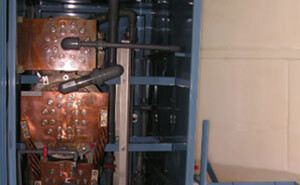
Each generator cabinet included three – 2 kg/h Electrichlor cells for a 6 kg/h system.
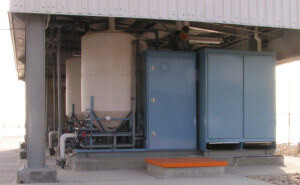
Each 6 kg/h Electrichlor system included a hypochlorite generator cabinet, transformer rectifier, and storage tanks.
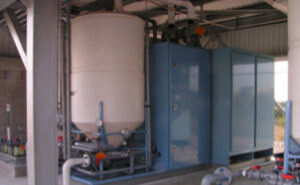
Two 6 kg/h systems are used in parallel for a 12 kg/h plant.
Result: Unparalleled Reliability and Longevity
Installed and commissioned in 2006, this Electrichlor system has been providing continuous biofouling control at the Altamira V power plant for more than 18 years. The average cell life in this system has been 9-10 years, far beyond the life of conventional electrochlorination cells.